
Vivian Criminal History Checks
Begin at the city level when the event involved a Vivian officer or a town citation. The town does not publish a dedicated police-record portal, arrest blotter, request form, municipal case search, or records email. A thorough Vivian record check therefore relies on direct contact and a precise written request. The source changes with the question. Police can identify an incident file; Town Hall can route a local docket inquiry; the Caddo Parish Sheriff can answer county booking questions; and the Caddo Clerk holds First Judicial District Court prosecutions.
- Call Vivian Police at 318-375-2914 to confirm that the department created the incident or arrest record and ask where to send the request.
- Describe the exact police material sought, including the event date, location, report number if known, and preferred delivery method.
- Ask Town Hall about a town ticket or Mayor's Court docket because no public municipal name search was found.
- Use the Caddo Parish arrest search routes for recent county custody, and the Clerk for a filed state-law case.
- For one's own full Louisiana record, use the fingerprint-linked State Police Right to Review process rather than assuming local files are statewide.
A booking entry is not a verdict. Follow any arrest result into the correct court file before describing the outcome.
Vivian Records at Town Hall
The official Town of Vivian site identifies the municipal contact point used when no special records counter or web form exists. Vivian Town Hall is at 112 West Alabama, Vivian, LA 71082. Mail goes to PO Box 832, Vivian, LA 71082. The main telephone number is 318-375-3856, and the fax is 318-375-5919. Those distinctions matter. Use the street address for an in-person visit, the post-office box for mailed requests, and the published fax when staff confirms that route is suitable.

The town source supports the contact route, but it does not turn Town Hall into a universal criminal-history repository. State the department, event, date range, and desired record. Ask staff to route the request to the lawful custodian if Town Hall does not keep it.
Vivian Town Hall
112 West Alabama
Vivian, LA 71082
Mail: PO Box 832
318-375-3856
Fax: 318-375-5919
Records at the Vivian Police Department
Vivian Police Department's official page gives the direct line, 318-375-2914, and describes a mission centered on protecting life and property, serving neighborhoods, maintaining order, solving problems, and apprehending offenders within the law and community values.
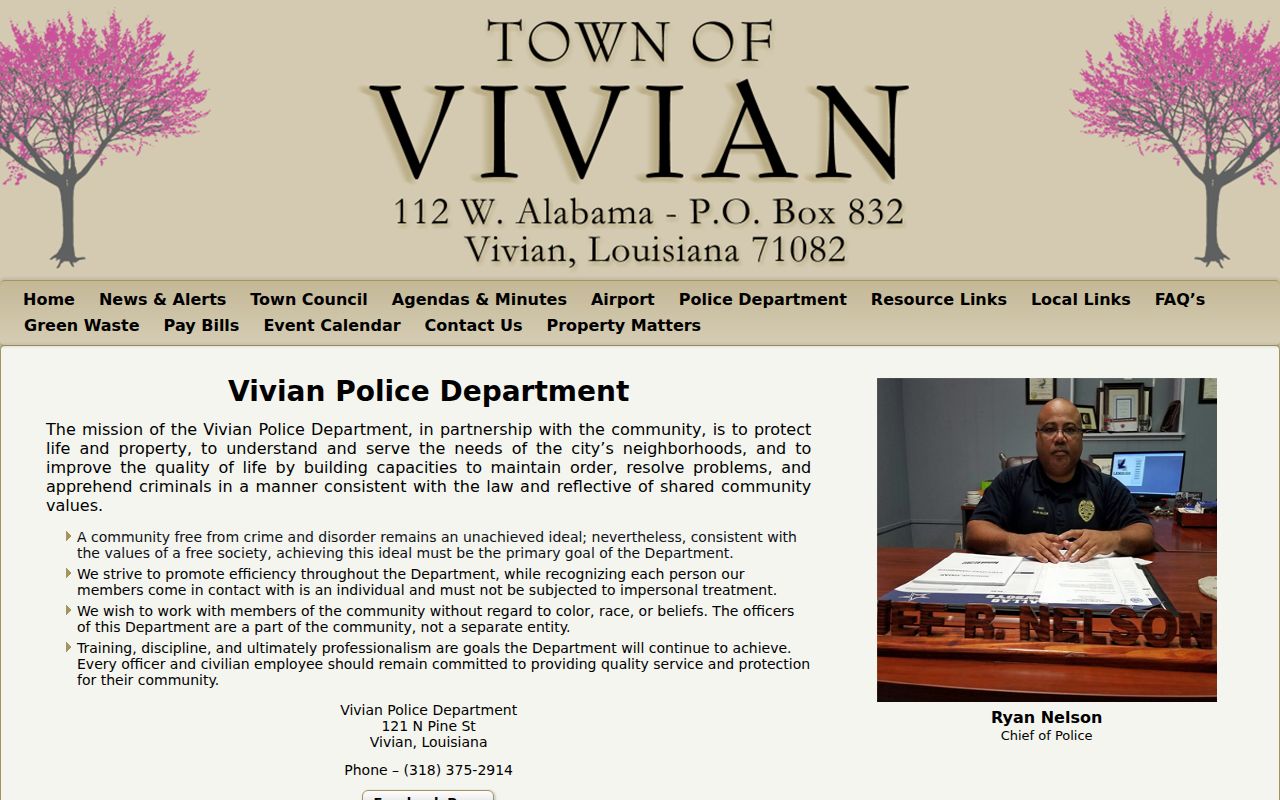
The department page confirms whom to call, yet it lists no dedicated records-unit hours or email. It also provides no report-request form or searchable report fields. Call first, then ask whether the responsive Vivian police record can be inspected, mailed, or sent another way. Do not send private identity documents until the department explains a secure and necessary method.
Useful drafting details include the requester's contact information, incident date and place, report number if known, the specific record, and a delivery preference. These are practical details, not claimed mandatory fields. A narrow request such as “the releasable incident report for the event at a stated place on a stated date” is easier to locate than a demand for every record about a broad topic.
No Online Vivian Record Portal
Vivian's public pages do not expose a police database, arrest blotter, municipal court lookup, or named mobile app. That negative finding is useful because it keeps searchers from mistaking an unrelated service for an official record source. There is no honest portal-field table to reproduce. Instead, preserve a copy of the written request, note the date it was delivered, and keep any reply that identifies the custodian or gives a reason for delay or withholding.
The Town Hall FAQ discusses ordinary town payment methods, including cash, check, or money order inside and possible card or check payment online.
That payment information does not establish a police-report copy fee. It also does not provide a criminal case search. Ask the record custodian for the current charge, if any, before sending payment, and do not infer a copy price from a utility, ticket, or other town payment screen.
Booking and Arrest Records in Vivian
A Vivian arrest can create several distinct records. The officer's department may hold the incident narrative and arrest report. A booking facility creates an intake entry with the alleged charges, time, identification data, bond, and custody status. If prosecutors file a state-law charge, the Caddo Clerk opens or updates a court case. These files answer different questions and may appear at different times.
No official Vivian jail roster or holding-facility page was located. Call Vivian Police to learn where the person was booked rather than stating that every city arrest automatically goes to Caddo Correctional Center. If police confirms a transfer to county custody, check the Sheriff's current inmate search and recent booking report. A recent city incident may still be absent from a county result if the person was cited, released, held elsewhere, or the data has not yet moved.
Note: An arrest record states an allegation and custody event; it does not prove guilt or reveal the final court result.
Tracing Vivian Arrest Records
Trace a Vivian arrest by keeping identifiers consistent from source to source. Record the person's full name, arrest date, agency, report or booking number, and alleged charge. Then compare the booking entry with the filed court charge. Prosecutors may decline a count, amend it, or file a different charge supported by the investigation. The court disposition may arrive well after the first jail entry.
For a state-law prosecution, the First Judicial District Court and Caddo Parish Clerk are the key county layer. The Clerk's index includes Caddo criminal cases from 1980, minutes from 1984, and scans from 2002, while older Vivian matters may require a manual or archive search. A daily docket is only a schedule. It can show a name, time, date, courtroom, judge, and section without proving that a hearing occurred or that a charge ended in conviction.
The Vivian Municipal Court File
No standalone Vivian Mayor's Court page or public name-based case lookup was found. Contact Town Hall for a town ticket, payment, docket, or copy question. For felony charges and parish-level state prosecutions, use the First Judicial District Court and the Caddo Clerk instead. The distinction prevents a local payment result from being presented as a complete court history.
| Court Name | Vivian Mayor's Court or municipal docket; confirm the current caption with Town Hall |
|---|---|
| Case Types Heard | Town ordinance and local ticket matters within municipal authority; state-law prosecutions belong in the proper parish court |
| Case Lookup Channel | Town Hall telephone, counter, mail, fax, or a focused records request; no public online name search was found |
| What the Docket Shows | Ask for the citation, settings, minutes, disposition, and payment status that are public and maintained |
| Copies & Fees | Confirm availability, format, and current copy cost with the custodian; town payment rules do not prove a records fee |
A court file is more than a balance due. Depending on the matter and access limits, it may contain a complaint or citation, docket entries, minute entries, plea, disposition, sentence, and financial entries. A “disposition” is the outcome of a charge. Ask for that field when the goal is to distinguish a conviction, dismissal, or other result.
Vivian Criminal Record Data Limits
Vivian does not publish a town annual crime report in the researched official channels. The FBI Crime Data Explorer may provide a Vivian agency-and-year entry, but any use needs its reporting-coverage notes. A blank value may mean no reported data, incomplete participation, or a system issue rather than zero crime. Parish-wide or Shreveport totals should not be substituted for Vivian figures.
The same care applies to personal records. A police report documents an investigation, a booking record documents custody, and a court file documents prosecution. A Louisiana repository history links fingerprint-based arrest cycles with dispositions received through the reporting chain. No one source reliably replaces the others. Verify dates, identifiers, and outcomes with the office that originated each entry.
How Vivian Records Reach the County
When Vivian Police makes a fingerprintable arrest, booking personnel create identity and arrest data for the state reporting chain. The Caddo District Attorney decides whether and what to charge in a parish prosecution. The Caddo Clerk receives filed charges, motions, minutes, warrants, dispositions, and other case material. A court result should later feed the state criminal-history record, although old paper files, unmatched identifiers, and reporting lag can cause temporary differences.
Record flow: Vivian Police Department › Caddo Parish Courts › Louisiana Department of Public Safety and Corrections, Office of State Police, Louisiana Bureau of Criminal Identification and Information
Use the first source for the incident, the booking custodian for current custody, the Clerk for charge and disposition, and LBCII for the subject's own fingerprint-linked Louisiana history. Older Vivian records may demand more than an online name check.
Vivian History and Record Context
The town's official Vivian history traces incorporation to 1898, after settlement shifted from Monterey, a former Caddo Lake port, and nearby lakes and woodlands toward a late-nineteenth-century railroad terminal.
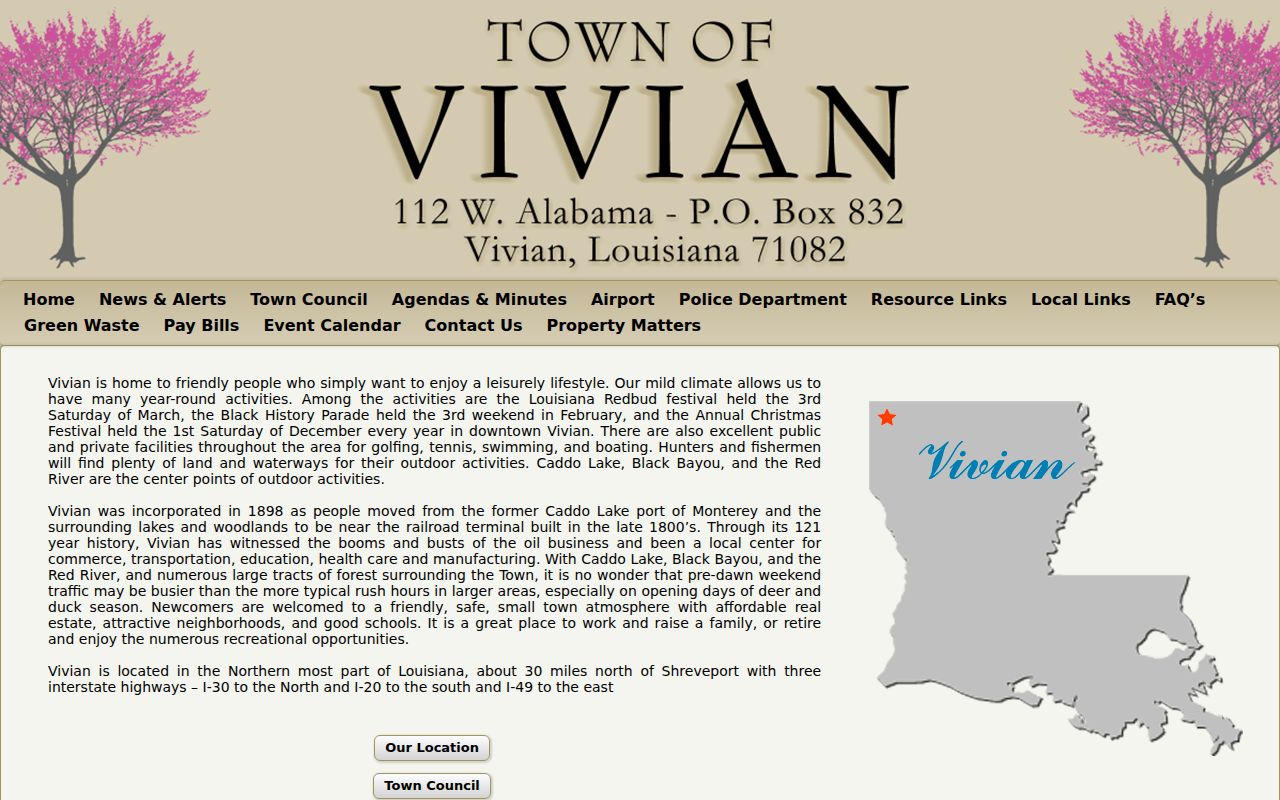
Later oil booms and busts shaped Vivian's civic development. The town remains about 30 miles north of Shreveport among Caddo Lake, Black Bayou, the Red River, and forest. That history helps explain why older records may sit in paper, municipal, parish, or state collections rather than one modern portal.
Annual gatherings include the Louisiana Redbud Festival on the third Saturday in March, the Black History Parade on the third weekend in February, and the downtown Christmas Festival on the first Saturday in December. These details describe local life and seasonal activity. They do not support claims about crime levels or enforcement patterns.
Writing a Vivian Records Request
Address a request to the office most likely to possess the record. Name the Vivian agency, give a focused date range, identify the incident or person with enough detail to locate the file, and specify whether inspection or a copy will work. For a police event, separate the incident report from 911 audio, dispatch logs, body-camera video, photographs, and arrest paperwork because each may be stored and reviewed differently.
- Provide a reliable name, mailing address, telephone number, or email for the response.
- State the event date and location, plus the report or citation number if known.
- Name each record sought rather than asking for an undefined “full background check.”
- Request electronic delivery, paper copies, or inspection, and ask for a cost estimate when needed.
- Ask for releasable portions if an exemption requires redaction of only part of the record.
Town staff may clarify a request, require reasonable identification in circumstances allowed by law, or explain that another custodian holds the file. Keep that reply. It provides a clear next step and a record of the request history.
Vivian Record Access Rules
Louisiana law starts with a right to inspect or copy public records, subject to specific exceptions. Vivian police and town records can contain protected juvenile information, victim details, medical facts, personal identifiers, active investigative material, or other exempt content. A custodian may redact protected fragments and release the rest. Judicial records follow the court and clerk's access rules, so do not assume every court filing is obtained through the same executive-branch request process.
Key Statutes:
Louisiana Public Records Law, La. R.S. 44:31 establishes the public right to examine or copy records, subject to exceptions provided by law.
Louisiana Revised Statutes 44:32 addresses custodian assistance, reasonable identification, copying charges, and written responses when a record is unavailable.
Louisiana Revised Statutes 15:587 controls LBCII dissemination, so statewide criminal history is not an unrestricted public people-search database.
Use public records law to seek an existing record, not to force an office to create a new background report or answer research questions. A lawful release can still be incomplete due to redaction, sealing, expungement, or limits on what the office maintains.